
In the modern financial landscape, a louder-than-ever narrative dominates headlines, podcasts, and social media platforms: “Invest directly into company shares, stocks, bonds, bypass middlemen, opt for direct plans, and save on distributor commissions, RIA fees etc. to maximize your wealth.”
On paper, this DIY (Do-It-Yourself) investment framework sounds incredibly seductive. Why pay an intermediary a fraction of a percentage when you can click a few buttons on a smartphone app for free?
However, this blog highlights that true portfolio growth comes from consistent financial behavior and expert stewardship over time, rather than just chasing low fees. Paper theories rarely survive the harsh friction of real-world market cycles. For an unguided investor—especially someone with zero understanding of asset allocation, market volatility, or mutual fund dynamics—focusing purely on the “cost” of a professional expert guidance isn’t just short-sighted; it is structurally hazardous to their financial health.
To uncover why the DIY narrative often fails exactly when investors need it most, we don’t need to look at theoretical simulations or optimistic back-testing. Instead, let us analyze a real-time, live case study of a portfolio deployed under professional expert guidance during one of the toughest market setups in recent history.
The Ultimate Portfolio Stress Test: A Case Study in Real Wealth Management
Imagine an individual with absolutely no prior exposure to equity markets who decides to start investing. They have no knowledge of fund managers, risk profiles, or macroeconomic indicators. They rely entirely on a professional expert guidance to construct, deploy, and navigate their wealth architecture.
Now, look at the timeline and the brutal market environment this portfolio had to endure:
- Date of Capital Deployment: 19 September 2024
- The Market Context: This capital was deployed right at the historic peak of the Indian equity markets. In fact, just days prior on September 19, 2024, the BSE Sensex peaked and closed above the historic 83,000 mark for the very first time—a massive rally triggered by the US Federal Reserve’s 50-basis-point interest rate cut.
- The Current Review Date: 13 August 2026
- The Broader Market Reality: From that historic peak in late September 2024 to mid-August 2026, the broader market index collapsed, dropping down into the sub-78,000 range. Specifically, between September 19, 2024 (Closing: 83,184.80) and August 12, 2026 (Closing: 77,966.35), the BSE Sensex recorded a net absolute loss of 5,218.45 points, translated to a net market loss of -6.27%.
For an individual investor navigating these market swings alone on a DIY platform, this kind of environment can be deeply stressful and test both emotional resilience and financial confidence. Buying at the exact top right before a two-year, -6.27% prolonged market contraction usually results in severe principal erosion and panic selling.
Yet, under dedicated professional expert guidance, look at the actual status of this client’s financial health:
| Portfolio Performance Metric | Real-Time Live Data |
|---|---|
| Total Invested Capital (Cost) | ₹2,60,000.00 |
| Current Portfolio Value (As of 13 Aug 2026) | ₹3,02,980.00 |
| Net Wealth Created (Absolute Gain) | +₹42,980.00 |
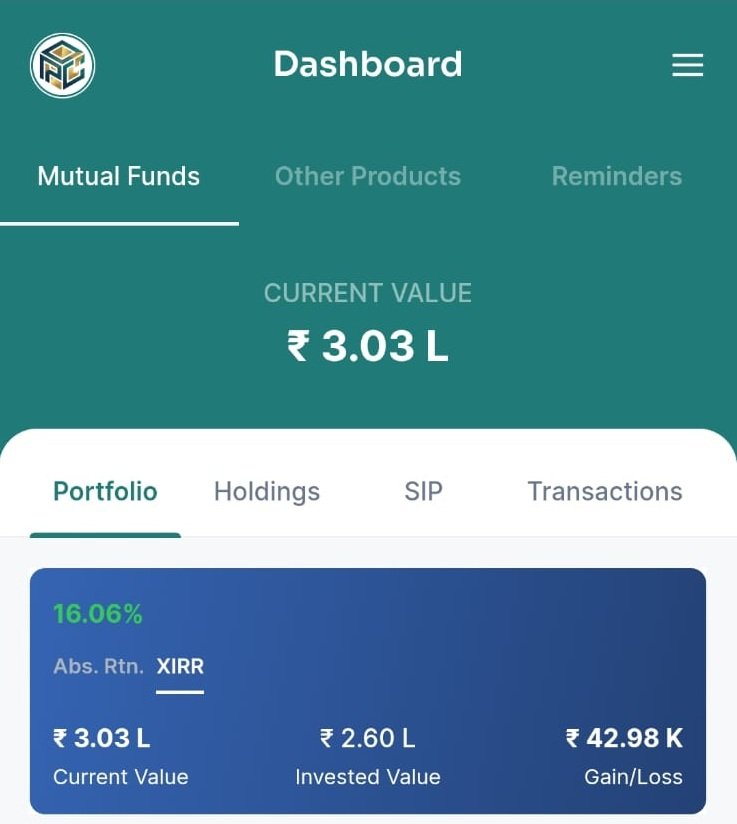
| Absolute Portfolio Return / XIRR Portfolio Return | 16.50%/ 16.06% |
| Broader Benchmark Index (Sensex) | -6.27% (Net Loss) |
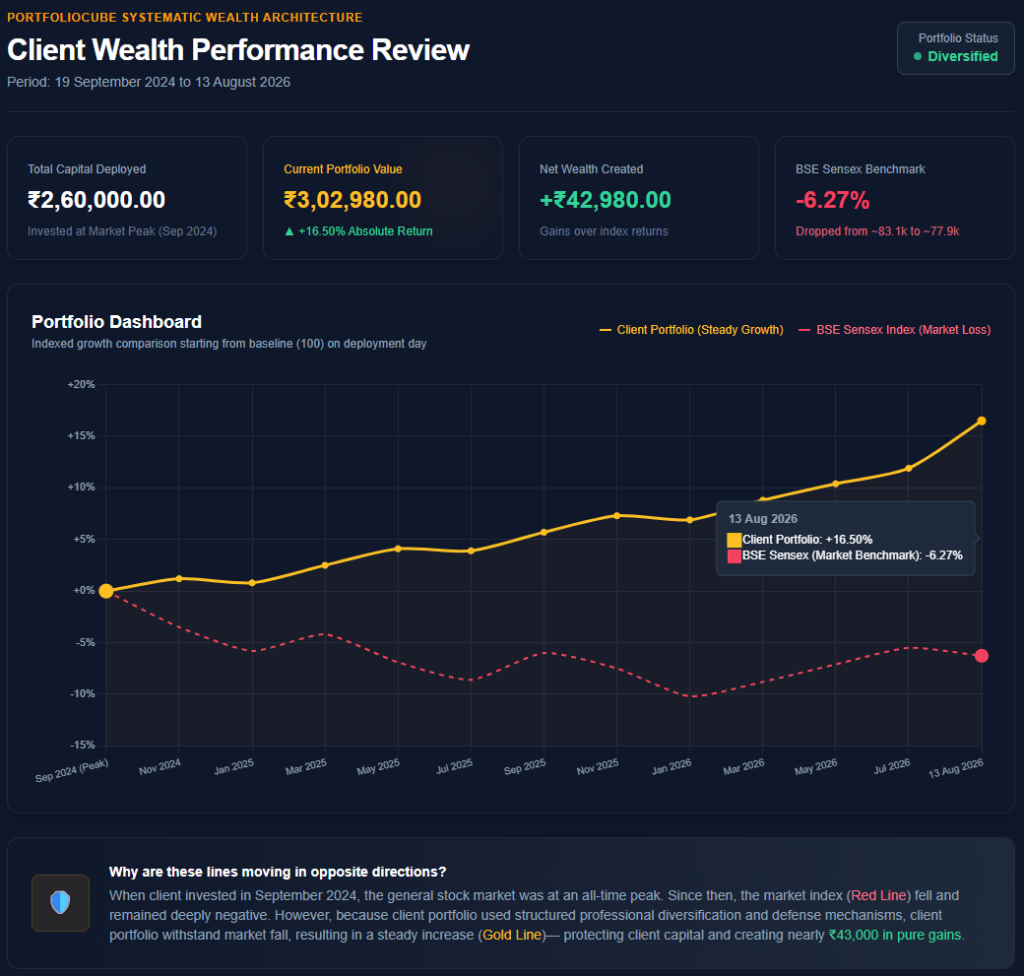
PortfolioCube Systematic Wealth Architecture
Client Wealth Performance Review Period: 19 September 2024 to 13 August 2026 | Status: Active Outperformance
| Total Capital Deployed | Current Portfolio Value | Net Wealth Created | BSE Sensex Benchmark |
| ₹2,60,000.00 | ₹3,02,980.00 | +₹42,980.00 | -6.27% |
| Invested at Market Peak (Sep 2024) | ▲ +16.50% Absolute Return | Pure alpha over index returns | Dropped from ~83.1k to ~78.0k |
Detailed Performance Breakdown
| Metric | Broader Market Benchmark (Sensex) | Expert-Guided Portfolio (PortfolioCube) | Performance Advantage |
| Deployment Level / (19 Sep 2024) | 83,184.80 (Historic Peak) | ₹2,60,000.00 (Invested Capital) | Perfect Market Peak Entry |
| Current Level (13 Aug 2026) | 77,966.35 (Market Contraction) | ₹3,02,980.00 (Current Value) | +₹42,980 Net Gain |
| Absolute Return | -6.27% Net Loss | +16.50% Net Gain | +22.77% Performance Gap |
| Annualized Return (XIRR) | Negative Growth | 16.06% XIRR | Consistent Wealth Growth |
The numbers reveal an important takeaway: These results illustrate the value of strategic planning: While broader indices navigated a 6.27% downturn during this two-year cycle (Sep’2024-Aug’2026), thoughtful asset allocation helped insulate the portfolio, delivering nearly ₹43,000 to secure a positive 16.50% absolute return with XIRR of 16.06%.
What specifically drove this difference in outcomes?
Beyond Do-It-Yourself (DIY): Understanding the Real Cost of Unassisted Investing
The anti-professional expert guidance narrative views commission/fees as a direct deduction from performance. If a regular plan charges an extra 0.5% to 1% per annum compared to a direct plan, critics assume the investor is automatically worse off by that exact percentage.
This narrow numerical perspective overlooks a fundamental reality of wealth building: preserving capital with positive net growth—such as achieving a 16.50% absolute gain (16.06% XIRR) through a staggered, diversified strategy—creates significantly greater value than a single, undiversified lump-sum bet that mirrors a 6.27% market decline.
Professional expert guidance support delivers three pillars of value that far outweigh the cost of fees/commissions:
1. Strategic Asset Allocation
When investing independently on a digital platform, it is natural for beginners to gravitate toward recent top performers. At the market peak in September 2024, an unassisted approach might have led an investor to allocate the entire ₹2.60 Lakhs into previously high-flying large-cap or thematic funds. However, as broader indices experienced a multi-year consolidation, that strategy could have resulted in prolonged stagnation and capital strain.
A professional expert guidance, conversely, designs a portfolio using structural defense mechanisms. By utilizing smart diversification, tactical allocations across multi-cap or flexi-cap frameworks, staggered deployment strategies (like SIPs or STPs), and hybrid configurations, the professional expert guidance built a resilient shield. The result? The portfolio generated strong positive returns even when the broader headline indices were sinking.
In current Client context this was achieved through the tactical allocation across dynamic asset allocation/hybrid funds, debt allocation, and staggered SIP investments.
2. Behavioral Coaching
The greatest threat to a portfolio isn’t the expense ratio; it is the investor’s own emotions. For a client with zero market knowledge, watching a hard-earned ₹2,60,000 drop in value during a market dip creates extreme psychological panic.
Left to their own devices on a direct trading app, an investor has no barrier between their anxiety and the “Sell” button. Millions of retail investors lock in permanent capital losses by panic-selling at the bottom of a market dip, only to watch from the sidelines as the market eventually recovers.
A professional expert guidance acts as an emotional circuit breaker. By providing reassurance, contextualizing short-term volatility, and maintaining long-term perspective, the expert prevents the client from making catastrophic emotional mistakes. This behavioral management is an invisible form of compounding that saves investors lakhs of rupees over their lifetime.
3. Administrative and Operational Competency
Investing isn’t a one-time event; it is a continuous operational journey. Managing KYC compliance, updating bank mandates, executing structural rebalancing, tracking dividend distributions, handling tax-loss harvesting, and navigating eventual estate planning or redemption cycles require substantial time and technical understanding.
For a beginner, these administrative hurdles are highly intimidating and prone to error. A professional expert guidance provides end-to-end operational fulfillment, transforming investment management from a stressful logistical burden into a completely seamless, stress-free experience.
Conclusion: The Truth About Value vs. Price
Price is what you pay; value is what you get.
The DIY investment movement wants you to focus exclusively on price. But as this real-time portfolio explains, a DIY (Do-It-Yourself) investing is only cheaper if you possess the expert knowledge to allocate assets correctly, the sophisticated tools to outperform index traps, and the emotional discipline to never panic during a multi-year market downturn.
When market experience is limited, professional guidance provides the discipline and clarity needed to stay anchored to one’s financial goals throughout the wealth-building process.
Pro Tip: DIY (Do-It-Yourself) investing work well for experienced, emotionless market veterans, but for the average investor juggling a career and family, professional guidance prevents costly mistakes
This client invested ₹2,60,000 at the worst possible time—the very peak of the market when the Sensex cleared 83,000. Without a staggered, diversified strategy, this portfolio could easily have mirrored the broader market’s -6.27% contraction. Instead, through structured asset allocation and proactive planning, the investor is experiencing steady resilience—accumulating nearly ₹43,000 in net gains despite a challenging market environment.
Navigating the markets without prior knowledge can be daunting, making trusted professional guidance invaluable for staying the course and achieving key financial milestones. When dedicated professional guidance safeguards your portfolio and steadily builds assets during volatile periods, partnering with an expert becomes an investment that truly enriches your financial future. That is the definition of true financial expert guidance, and it is precisely why trusted professional guidance serves as an invaluable anchor, helping investors navigate their wealth creation journey with clarity and confidence.
Want a look at how your own portfolio’s allocation and timing strategy holds up under a similar stress test? Reach out via PortfolioCube for a personalized portfolio review.
Disclaimer: Mutual Fund investments are subject to market risks. Please read all scheme related documents carefully before investing. Past performance is not indicative of future returns. Nawneet Kumar Panjiyar is an AMFI Registered Mutual Fund Distributor (ARN 303470) and does not provide investment advisory services in the capacity of a Registered Investment Adviser. Nothing on this page constitutes investment advice; please consult scheme documents and, where appropriate, a qualified financial adviser before making investment decisions.
Thought provoking! Excellent illustrations with real time portfolio example.
Thank you, Priyanshu! Real numbers tend to land better than theory alone, so glad the illustration made the concept concrete rather than abstract.
Insightful. Must read for all DIY investors.
Thank you, MV! Though I’d gently reframe it slightly — this isn’t really an argument against DIY investing itself, more a look at what strategy and discipline can do regardless of which route someone takes. Appreciate you reading it closely enough to engage.
I am a DIY investor for over a decade. I can attest to the fact the author is trying to address. The DIY investing has huge learning curve. Your mistakes, judgement error will be disproportionately very high initially. Only over a substantial period of time not less than seven years (in my case) you will learn the initial ropes of investing. In order to save penny money on fees; majority of DIY investor portfolio will severely underperform benchmark index. The investing is very time consuming and it should be done on full time basis to take the best advantage as a DIY investor. For many retail individuals professional guidance is a must. It saves lot of time so that one can devote time and energy into current field of profession of earning bread and butter.
RetinaTruth,
Thank you for sharing such a candid and authentic perspective from over a decade in the trenches. Coming from someone with a decade of actual DIY experience, this carries far more weight than anything I could claim in the post itself.
You’ve touched on a fundamental truth that often gets lost in fee debates: time, emotional energy, and the steep learning curve are real costs. For seasoned investors who treat market analysis as a serious craft, DIY can work, but for individuals focusing on their own demanding careers, having dedicated guidance allows them to stay disciplined without bearing the burden of costly trial-and-error.
The point about the learning curve is especially well put; most people underestimate how long it takes to develop real judgment, not just knowledge. And the time/opportunity-cost angle is one I don’t emphasize enough — the real cost of DIY isn’t just mistakes; it’s the hours pulled away from one’s actual profession.
Really appreciate you taking the time to share your real-world experience here!
This is a very insightful perspective on the often-overlooked “discipline dividend” in investing. The real-world portfolio example makes the point particularly well—successful investing isn’t just about minimizing costs, but also about asset allocation, consistency, emotional discipline, and staying invested through challenging market cycles. The emphasis on behavioral coaching and avoiding costly emotional decisions is especially relevant for long-term investors. A valuable read for anyone trying to understand the difference between simply investing and investing with a well-defined strategy.
Amit Kumar
Thank you, Amit — and you’ve captured the actual point better than most summaries could. It really is about the combination — allocation, consistency, and the discipline to stay invested — not any single factor on its own. Appreciate you reading it that closely.
As a practicing medical Doctor in the heart of capital city of India i.e. New Delhi, I completely align with the author’s perspective. Whether in medicine, law, engineering, or finance, domain expertise is irreplaceable. In wealth management, having seasoned professional guidance is paramount—it preserves mental bandwidth, mitigates unnecessary anxiety, and allows professionals to focus fully on their core demanding careers.
I often view DIY investing through a clinical lens: treating a minor symptom at home is fine, but self-medicating a critical condition or performing self-surgery is unthinkable. Navigating long-term financial milestones is a high-stakes endeavour that warrants specialized care. High-stakes financial goals demand structured, professional stewardship rather than unassisted trial-and-error. DIY investing requires a full-time commitment that most working professionals simply cannot afford. Successfully managing capital solo always demands full-time commitment and years of market experience. Having realized this early in my own journey, partnering with an expert has proven to be the most prudent decision for my financial well-being. This blog is worth reading for all kind of investors.
Dr. Manoj Kumar
Thank you, Doctor — and it’s a real pleasure to see you engaging with the blog too, not just the portfolio side of things. The clinical lens you’ve applied here is a genuinely sharp way to frame it — the line between “manageable on your own” and “needs a specialist” applies far more broadly than people usually credit, and hearing it from someone who lives that distinction professionally every day carries real weight. Really appreciate you taking the time to write this out in full.
Awesome article, with fact & figures. But still people try DIY under the guidance of so called fininfluncers and sites giving a high level guidance but they cannot be replaced by the experience and hand holding a human can do.
Thaks Nawneet for the article.
Waiting to read more such articles from you.
Rajat
Thank you, Rajat — and well put. Generic guidance can tell you what a good strategy looks like in theory; it’s much harder for it to actually sit with you through a downturn, adjust when your life circumstances change, or catch something specific to your situation that a general framework wouldn’t flag. That’s usually where the real value of hands-on guidance shows up. Glad the facts and figures made the case concretely rather than just in theory — more articles on the way, appreciate you following along.
Nice as a newbie I felt very informative. Thanks
Ajai
Thank you, Ajai! Glad it landed well as a starting point — that’s exactly who this was written for. Welcome, and hope you find the rest of the blog useful as you get further into investing.