

Why Retirement Planning in India Needs More Than a Single Number
Most retirement calculators available in India today ask for one figure—your current savings—and return one number: your target corpus. That single-input, single-output approach misses two critical realities:
- Asset Fragmentation: Most working professionals do not hold their savings in one place. Portfolios are distributed across equity mutual funds, EPF, NPS, fixed deposits, and other instruments—each compounding at meaningfully different rates.
- The Drawdown Dynamic: A retirement corpus is not a finish line; it marks the start of a multi-decade drawdown where cash-flow management matters just as much as accumulation.
A realistic plan models both phases explicitly rather than collapsing them into a single, oversimplified assumption.
Understanding Your Retirement Corpus Required (RCR)
Your Retirement Corpus Required (RCR) is the lump sum needed on the day you retire to fund your remaining lifestyle. This figure accounts for the longevity of your assets alongside the compounding returns earned while systematically drawing down funds.
It is not simply your monthly expense multiplied by the years you expect to live. True RCR calculations balance living costs rising with inflation against the growth generated by your remaining invested balance. Underestimating inflation or overestimating post-retirement returns will distort the corpus requirement significantly, which is why your plan must allow you to stress-test both variables independently.
Why a Multi-Asset Approach Changes the Outcome
A balanced retirement plan relies on instruments that serve distinct functional roles across your timeline:
- Fixed Income & Provident Funds (EPF/PPF): Deliver steady, predictable compounding with low risk, anchoring your capital base.
- National Pension System (NPS): Offers a hybrid market-linked structure tailored to your chosen equity-to-debt asset allocation across working decades.
- Equity Mutual Funds: Provide the long-term capital appreciation necessary to beat lifestyle inflation, counterbalanced by short-term volatility.
- Fixed Deposits: Offer high liquidity and predictability, but produce the lowest real post-tax returns.
A model that consolidates these instruments into an aggregated return rate obscures where your corpus actually originates. Tracking each asset class separately—both during accumulation and across annual drawdown projections—clarifies whether your current asset mix will genuinely support your targets.
The Life Expectancy Trap: Why Your Retirement Horizon Is Longer Than You Think
India’s average life expectancy at birth sits near 72–73 years. Basing a retirement horizon on that baseline is a structural planning error.
Life expectancy at birth is pulled downward by early-life mortality. An individual who reaches age 60 has already survived these early risks and statistically holds a much longer remaining lifespan. Planning around birth-cohort benchmarks risks underfunding a retirement that could easily span 25 to 35+ years. Target an assumed longevity well above national headline figures to avoid outliving your savings.
The Dual-Inflation Trap: Lifestyle vs. Healthcare Inflation
Applying a single, blanket inflation rate leaves your portfolio vulnerable to the steepest cost curve in later life.
- General Lifestyle Inflation: Typically trends between 5% and 7%.
- Healthcare Inflation: Routinely compounds at 12% to 14% due to the rising costs of specialized treatments, hospitalizations, and health coverage.
A portfolio indexed only to consumer inflation may stay adequately funded for day-to-day living while falling dangerously short on medical expenses in your 70s and 80s. Protect your plan by building a safety buffer or earmarking a dedicated healthcare reserve.
Understanding Safe Withdrawal Rate (SWR) and Corpus Longevity
Determining your target corpus is only half the battle; establishing a viable Safe Withdrawal Rate (SWR) keeps it solvent. Rather than treating your withdrawal as an arbitrary percentage, monitor the full year-by-year trajectory of your portfolio. A dynamic drawdown model pinpoints when your corpus will peak and flags any risk of premature depletion across your planning horizon.
Common Retirement Planning Mistakes in India
The primary pitfalls modern retirement models aim to resolve include:
- Assuming a single blended rate of return across distinct asset classes.
- Underestimating retirement longevity by using life expectancy at birth instead of remaining life expectancy at age 60.
- Applying general lifestyle inflation to healthcare and critical care expenses.
- Treating corpus accumulation as the finish line without testing portfolio sustainability through a multi-decade drawdown.
Retirement Planning 2026: Corpus, SIP & SWP Advanced Calculator
To map these moving parts accurately, salaried professionals require a multi-asset framework. This system calculates the required corpus, maps out the necessary monthly SIP, establishes a sustainable SWP schedule, and summarizes your status via a single Retirement Readiness Score.
📊 Test Your Own Numbers
Now that you understand why standard, flat-rate calculators fall short, you can model your own retirement path using our advanced framework.
As you use the tool below, try adjusting these two specific levers to see how they impact your corpus:
- The Longevity Buffer: Push your life expectancy from age 80 to 90 and observe the compounding deficit.
- The Healthcare Wedge: Separate your medical inflation from your standard living expenses to see the true cost of care in your 70s.
[Calculate your Retirement Readiness Score using the Multi-Asset Advanced Calculator →]
How to Use the Calculator
- Enter your current monthly expenses, current age, planned retirement age, and target life expectancy into the Goal Basics module.
- Set distinct inflation and return assumptions for both pre-retirement accumulation and post-retirement drawdown.
- Detail your current holdings across Equity Mutual Funds, EPF, NPS, Fixed Deposits, and other assets alongside your monthly investments.
- Review your Retirement Readiness Score, Total Future Liquid Assets, and Annual Safe Withdrawal Rate. Adjust variables—such as extending retirement by two years or stepping up your SIP—to visualize the exact impact on your timeline.
Actuarial Case Study: Calculating the Required Corpus
Below is a complete mathematical breakdown showing how the calculator applies the Fisher Equation to determine capital requirements:
Client Profile & Assumptions:
- Current Age: 40 years
- Target Retirement Age: 50 years
- Life Expectancy: 85 years
- Current Monthly Expenses: ₹1,00,000
- Pre-Retirement Inflation: 6.0% p.a.
- Pre-Retirement Return: 12.0% p.a.
- Post-Retirement Inflation: 8.0% p.a.
- Post-Retirement Return: 10.0% p.a.
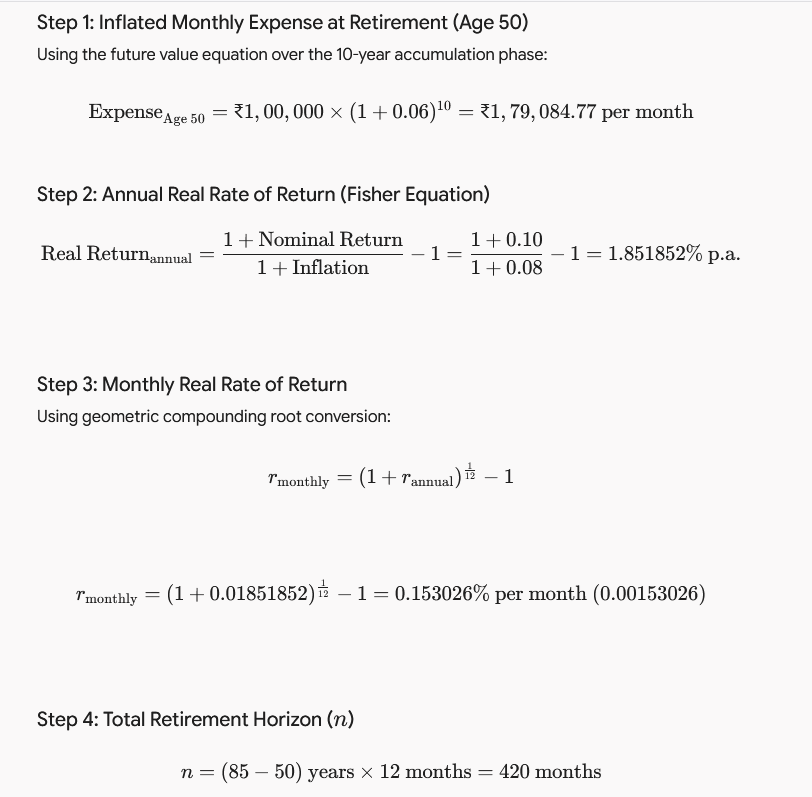
Step 5: Present Value (Corpus Required at Age 50)
| Excel Argument | Value to Enter | Parameter Context |
| Rate | 0.00153026 | Monthly compounded real rate of return |
| NPER | 420 | Total monthly distributions across 35 years |
| PMT | -179084.77 | Monthly inflation-adjusted expense (cash outflow) |
| [FV] | 0 | Full capital consumption by age 85 |
| [Type] | 1 | Annuity Due (withdrawals at the beginning of each month) |

- Retirement Corpus Required (RCR): ₹5,55,42,017 (~₹5.55 Crores)
📋 To close the ₹5.55 Cr RCR shortfall at the age of 50 years:
Assuming no prior investment and starting from zero at the age of 40 years,
- the client needs to do SIP of ₹2,47,916 from today or
- to do the lumpsum investment ₹1,78,83,043 today
- Retiring later alone will not close this gap within 25 years
- Reduce your retirement expense target
Disclaimer: Mutual Fund investments are subject to market risks. Please read all scheme-related documents carefully before investing. Past performance is not indicative of future returns. Nawneet Kumar Panjiyar is an AMFI-Registered Mutual Fund Distributor (ARN 303470) and does not provide investment advisory services in the capacity of a Registered Investment Adviser. Nothing on this page constitutes investment advice; please consult scheme documents and, where appropriate, a qualified financial adviser before making investment decisions.
As a government employee, I must commend the team for building what is easily the most comprehensive multi-asset retirement planning tool available online for the Indian context.
The tool accurately maps diverse asset classes alongside their individual return profiles, reflecting the real-world financial realities faced by salaried professionals across both the public and private sectors. The step-by-step breakdown of the calculations leaves no room for ambiguity, and when applied to my personal finances, the Retirement Readiness Score proved to be an invaluable, actionable metric.
This advanced calculator is an essential resource for any salaried individual—whether they are just starting to contemplate retirement or actively planning it. The blog content is well written and explained in lucid manner. Kudos to the entire team on an outstanding initiative; keep up the excellent work!
Thank you so much, Manish — this genuinely means a lot.
I especially appreciate you sharing that you applied it to your own finances. As a government employee, your asset mix (NPS, GPF, pension components) is exactly the kind of “fragmented across instruments” picture the calculator was built to bring together in one place — so hearing that the Readiness Score gave you something concrete and actionable is exactly the outcome I was hoping for when building this.
If you’d ever like to walk through your specific numbers in more depth or talk through how to act on your Readiness Score, feel free to reach out anytime via the Contact page or portfoliocube.in.
Thanks again for taking the time to write such a thoughtful comment — it’s genuinely encouraging.
— Nawneet